
Plantation Shutters in Port Huron: Custom Options for Light Control, Privacy, and Lasting Style
Plantation shutters in Port Huron can give windows a clean, tailored appearance while providing practical control over natural light, privacy, and exterior views. Unlike treatments that are raised or rolled into a headrail, shutters become a more permanent visual part of the window. Their framed construction and adjustable louvers create an architectural look that can work in traditional, transitional, and contemporary homes.
For homeowners considering plantation shutters in Port Huron, the process involves more than choosing a color. Shutters must be designed around the size, depth, shape, and operation of each window. Material, louver width, panel configuration, mounting method, tilt mechanism, and frame style can all affect the finished result.
Port Huron and the surrounding Michigan communities experience cold winters, warm summer sunlight, and changing seasonal conditions. A properly fitted interior shutter can provide a useful additional layer at the window while making it easy to adjust sunlight throughout the day. Shutters can also provide dependable privacy without requiring cords or large amounts of fabric.
Understanding the available choices will help you determine where plantation shutters make sense in your home and how to customize them for each room.
What Are Plantation Shutters?
Plantation shutters are interior window treatments consisting of a fitted frame, hinged panels, and horizontal louvers. The louvers rotate to change the amount and direction of light entering the room. The panels can typically swing open when you want direct access to the window or a less obstructed view.
The term “plantation shutters” is commonly associated with shutters that have wider louvers, although several louver sizes may be available. They are also frequently described simply as custom interior shutters.
A typical shutter includes:
A frame attached within or around the window opening
One or more hinged panels
Adjustable horizontal louvers
A tilt mechanism that moves the louvers
Hinges connecting the panels to the frame
Optional divider rails or independently controlled louver sections
Magnets or catches that help hold panels closed
Because a shutter has rigid frames and panels, exact measurements are essential. The product must fit the opening while allowing the louvers, panels, window locks, and handles to operate correctly.
Why Choose Plantation Shutters for a Port Huron Home?
Plantation shutters are chosen for both their appearance and functionality. They provide an alternative to soft fabric treatments and can complement many different types of residential architecture.
Adjustable Light Control
Shutter louvers can be tilted through a range of positions. Instead of completely uncovering the window, you can redirect sunlight away from seating areas, television screens, or work surfaces.
Tilting the louvers upward may allow daylight into the room while limiting direct views through the window. Tilting them downward can change the path of sunlight and reduce glare from another angle.
The best position will vary based on the direction of the window and the time of day. This adjustability makes shutters useful in rooms where lighting conditions change frequently.
Privacy Without Completely Blocking Daylight
Closing a shade usually covers the window from top to bottom. Shutters offer more ways to balance privacy and natural light.
A shutter with independently controlled upper and lower louvers can keep the lower portion closed while allowing light through the top. This can be valuable for street-facing rooms, bedrooms, bathrooms, and home offices.
The louver angle also lets you limit visibility without necessarily darkening the entire room. At night, the louvers and panels can be fully closed for greater privacy.
A Structured, Finished Appearance
Plantation shutters have a substantial appearance because they are fitted with their own frames. When the frame style, panel divisions, and finish coordinate with the window, the treatment can feel integrated into the room.
White and neutral finishes create a crisp appearance and can coordinate with painted trim. Stained wood shutters highlight natural grain and may complement woodwork, cabinetry, or flooring.
Straightforward Operation
Shutters do not need to be wound around a tube or gathered into fabric folds. The louvers can be adjusted directly, and the panels swing open on hinges.
This can make them easy to use on accessible windows. However, panel clearance must be considered carefully so nearby furniture, walls, or fixtures do not prevent the shutters from opening.
Cord-Free Design
Plantation shutters operate without lift cords. Their louver and panel controls are built into the product, giving the window a streamlined appearance.
The absence of hanging cords can also make shutters a practical choice for households with children or pets.
Plantation Shutters and Michigan’s Seasonal Climate
Windows can contribute to uncomfortable indoor temperatures during both winter and summer. Cold glass can make the area near a window feel chilly, while strong sunlight can raise temperatures in exposed rooms.
When shutter panels and louvers are closed, they create an additional barrier between the glass and the room. This may help reduce air movement and make the immediate window area feel more protected.
During summer, the louvers can be adjusted to limit direct sunlight. Blocking or redirecting intense sun before it heats the room can improve comfort, particularly at windows with strong afternoon exposure.
Shutters are not a replacement for well-maintained windows or proper insulation. Their performance also differs from that of cellular shades, which use enclosed fabric cells to trap air. Homeowners who consider insulation a leading priority should compare the performance, appearance, and operation of both products.
The advantage of shutters is their ability to combine adjustable louvers, a fitted frame, privacy, and a durable architectural design.
Wood Plantation Shutters
Wood shutters provide natural character and a furniture-quality appearance. Depending on the collection, they may be available in painted colors or stained finishes.
Real wood can be strong without being excessively heavy, which may make it suitable for certain larger panels. The exact size limits depend on the wood species, construction, and manufacturer.
Painted Wood Shutters
Painted wood shutters provide a smooth, finished appearance while retaining the construction and feel of real wood. Neutral painted finishes can coordinate with many wall colors and interior styles.
If the goal is to coordinate with window trim, physical samples should be viewed in the room. White finishes can have warm, cool, cream, or gray undertones that become more apparent beside existing paint.
Stained Wood Shutters
Stained shutters reveal the wood grain and natural variation. They can work especially well in homes with stained trim or visible wood details.
Because wood is a natural material, variation in color and grain is expected. A small sample provides a general representation but will not show every characteristic of the finished panels.
Where Wood Shutters Work Best
Wood may be appropriate for living rooms, dining rooms, bedrooms, offices, and other areas where natural material and finish quality are priorities.
Environmental conditions should also be considered. A window treatment professional can recommend whether wood or another material is most suitable for a room with elevated moisture or temperature changes.
Composite Plantation Shutters
Composite shutters use engineered materials designed for consistent appearance and reliable performance. Many are finished to resemble painted wood.
These shutters are frequently available in popular neutral colors. They may be selected for durability, consistent finishing, and suitability for frequently used spaces.
Construction varies substantially among composite products. Important differences may include:
Material density
Internal reinforcement
Panel weight
Maximum panel width
Hinge construction
Surface finish
Moisture resistance
Warranty coverage
A higher-quality composite shutter should be evaluated as a complete product rather than grouped with every other synthetic option.
Because composite panels may weigh more than comparable wood panels, panel dimensions and hinge support require careful planning.
Vinyl and Polymer Shutters
Vinyl or polymer shutters can be appropriate for certain rooms, particularly where moisture resistance is important. These products may offer a smooth, uniform finish and straightforward maintenance.
Some synthetic shutters contain internal reinforcement to improve rigidity and support larger sizes. Others may have stricter size limitations.
Before selecting a vinyl or polymer product, ask about:
Whether the panels are reinforced
Maximum supported dimensions
Louver stability
Available colors
Recommended room conditions
Cleaning requirements
Manufacturer warranty
Material should be selected according to the specific application rather than price alone. A product that works well on a compact bathroom window may not be suitable for an expansive living-room opening.
How to Choose a Shutter Material
The best shutter material depends on the home, room, and window. There is no single option that is right for every installation.
Consider the following questions:
Do you prefer a painted or stained appearance?
Is natural wood important to the design?
Will the shutter be exposed to elevated moisture?
How wide and tall is the window?
How many panels will be required?
How often will the panels be opened?
Does the manufacturer recommend the product for the application?
What warranty is provided?
How does the shutter feel when operated?
Does the finish coordinate with the surrounding trim?
Viewing full-size shutter displays can reveal differences that are difficult to see in photographs. Panel weight, louver movement, hinge quality, and surface appearance are easier to evaluate in person.
Choosing the Right Louver Size
Louver width affects the scale, view, and overall character of a plantation shutter. Wider louvers create fewer horizontal lines across the window, while narrower louvers create a more detailed pattern.
Wider Louvers
Wider louvers often look proportionate on large windows. They can provide a broader opening between the slats when tilted, which may preserve more of the exterior view.
Their streamlined appearance works well in contemporary and transitional rooms, but they can also complement traditional interiors.
The window must have enough depth to accommodate the louver movement. A wider louver may require more clearance within the opening.
Narrower Louvers
Narrower louvers create a more traditional or finely detailed appearance. They may be a natural fit for smaller windows or rooms with more intricate architectural features.
Because more louvers are needed to fill the panel, additional horizontal lines will be visible.
Matching the Louver to the Window
Louver size should be proportional to the window and appropriate for the desired view. A wide louver may overwhelm a very small opening, while a narrow louver can appear visually busy across a large expanse of glass.
Compare actual samples at a realistic scale before making the final decision.
Traditional Tilt Rods and Hidden Tilt Systems
The tilt mechanism connects the louvers so they move together. Its design has a noticeable effect on the shutter’s appearance.
Traditional Tilt Rod
A traditional tilt rod is mounted on the front of the shutter panel, usually in the center or slightly offset. Moving the rod changes the louver angle.
This visible control contributes to the familiar, classic appearance associated with plantation shutters.
Hidden Tilt
A hidden or rear tilt mechanism reduces visible hardware on the front of the panels. Depending on the product, the connecting mechanism may be positioned along the rear edge or incorporated into the shutter construction.
Hidden tilt emphasizes the clean horizontal lines of the louvers and may appeal to homeowners who prefer a streamlined design.
Selecting a Tilt System
One option is not universally better. The decision comes down to appearance, operation, product availability, and personal preference.
Operate both types in person. A full-size sample will provide a better understanding of how the louvers respond and how prominent the mechanism will look on the window.
Full-Height Plantation Shutters
Full-height shutters cover the window from top to bottom. They offer complete coverage and create one continuous framed treatment.
This configuration is popular because it provides flexible privacy and light control throughout the opening. The panel may include a divider rail or separate louver sections.
Full-height shutters can work well in:
Living rooms
Bedrooms
Dining rooms
Home offices
Kitchens
Bathrooms
Street-facing rooms
On tall windows, the panels may need to be divided or configured carefully to remain stable and easy to operate.
Café-Style Shutters
Café shutters cover only the lower portion of a window. The upper glass remains uncovered, allowing natural light and exterior views above the shutter.
This configuration can provide eye-level privacy without covering the entire opening. It may be suitable for certain dining areas, kitchens, home offices, or windows where upper-level privacy is not necessary.
Café shutters do not provide full-window coverage, so they offer less control over sunlight, nighttime privacy, and insulation than a full-height design.
Before choosing café shutters, evaluate the view into the room from outside at different times of day. The uncovered upper glass may provide more visibility than expected when interior lights are on.
Tier-on-Tier Shutters
Tier-on-tier shutters include separate upper and lower sets of panels. Each tier can open independently.
For example, the lower panels can remain closed for privacy while the upper panels swing open to expose the glass. This provides more flexibility than a single full-height panel.
The configuration includes additional frames, hinges, and visible divisions. It may also require more adjustment during installation.
Tier-on-tier shutters are useful in particular situations, but they are not always necessary. A full-height shutter with independently controlled upper and lower louvers may provide sufficient flexibility with fewer panel divisions.
Divider Rails and Independent Louver Control
A divider rail is a solid horizontal section built into the shutter panel. It separates the upper and lower groups of louvers.
The rail can often be positioned to align with a horizontal sash or other structural feature of the window. This helps the shutter divisions feel connected to the window behind them.
Divider rails allow the upper and lower louvers to be tilted separately. The lower section can be closed for privacy while the upper section remains open for daylight.
Some product lines can provide separate louver control without a prominent divider rail. Availability depends on the manufacturer and panel dimensions.
When several shutters are installed in the same room, consistent divider-rail heights help create a coordinated appearance.
Selecting the Number of Shutter Panels
Panel configuration affects the view, weight, operation, and appearance of the shutter.
One Panel
A single panel creates fewer vertical lines and may work well on a narrow window. The panel must remain within the manufacturer’s size and weight limits.
It also needs sufficient room to swing open without striking a wall, fixture, or piece of furniture.
Two Panels
Two panels can meet in the center and open toward opposite sides. This produces a balanced appearance and can make each panel easier to operate.
Whenever possible, the meeting stiles should align with a vertical division in the window.
Multiple Panels
Wide windows may require three or more panels. The configuration should coordinate with window mullions while maintaining manageable panel widths.
Too many narrow panels can clutter the view. Panels that are too wide may become heavy or extend too far into the room when opened.
Professional planning is essential for finding the right balance.
Inside-Mounted Plantation Shutters
An inside-mounted shutter fits within the window opening. This creates a recessed appearance and may leave existing trim visible.
The opening must provide enough depth for the shutter frame and louver movement. Window locks, handles, cranks, and tilt-in sashes must remain accessible.
Because window openings are not always perfectly square, measurements should be taken at several points. The installer may use an appropriate frame profile to help create a balanced fit.
Inside mounts work well when:
The opening has sufficient depth
The trim should remain exposed
Window hardware will not interfere
The opening can accommodate the frame
A recessed appearance is preferred
A shallow opening does not necessarily rule out shutters, but it may require a different mounting approach.
Outside-Mounted Plantation Shutters
An outside-mounted shutter is positioned around the window opening. It may attach over the trim or to the surrounding surface, depending on the frame and window conditions.
Outside mounts may be recommended when:
The opening is too shallow
Locks or handles interfere with an inside mount
The window is significantly out of square
Additional coverage is desired
The existing trim is unsuitable for a recessed frame
Because an outside mount extends beyond the opening, its dimensions and relationship to nearby walls must be reviewed carefully. The frame should look proportional and have enough space for secure installation.
Plantation Shutters for Living Rooms
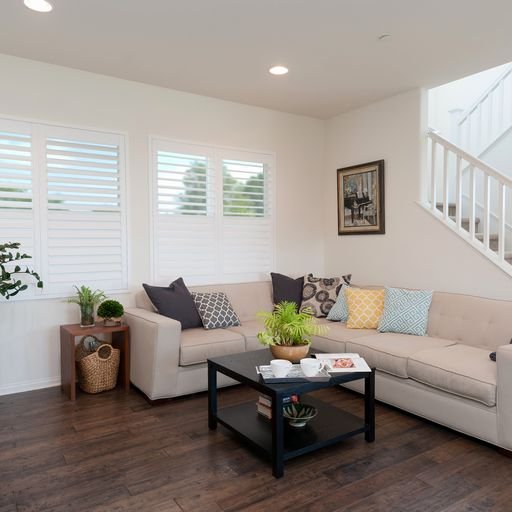
Living rooms often have multiple windows or larger openings that become prominent features of the space. Plantation shutters can provide a consistent, structured treatment across the grouping.
The louvers can be adjusted to reduce glare on televisions while preserving daylight elsewhere in the room. In the evening, closing the louvers increases privacy.
For several adjacent windows, consider:
Keeping frame profiles consistent
Aligning divider rails
Coordinating panel divisions with window mullions
Selecting a louver size appropriate for the entire grouping
Confirming that panels have room to open
Accounting for furniture near the windows
Even small alignment differences can become noticeable when shutters are installed side by side. Custom measuring and installation help create a unified result.
Plantation Shutters for Bedrooms
Bedrooms require privacy throughout the day and night. Full-height shutters allow the louvers and panels to close across the entire window.
Independent upper and lower louver sections can preserve privacy at the lower part of the window while admitting daylight above.
Although closed shutters reduce incoming light, they do not necessarily create complete darkness. Light can enter between movable louvers and around panel edges.
If a very dark sleeping environment is a priority, shutters may be combined with custom drapery. The drapery hardware and shutter panel clearance must be planned together so both treatments remain functional.
Plantation Shutters for Bathrooms
Bathrooms benefit from a treatment that provides dependable privacy while tolerating the conditions around the window.
Composite, vinyl, or polymer shutters may be appropriate depending on the amount of moisture and the manufacturer’s recommendations. Material selection is especially important near tubs, showers, or sinks.
A split-louver design can keep the lower section closed while allowing natural light through the upper portion.
The window must also be evaluated for:
Tile surrounding the opening
Limited mounting depth
Nearby fixtures
Window cranks
Locks and handles
Ventilation conditions
Panel-opening clearance
A customized design addresses these constraints before the shutter is manufactured.
Plantation Shutters for Kitchens
Shutters can provide a clean, tailored appearance in kitchens while making it easy to manage changing sunlight.
At windows above sinks or counters, the panels may be difficult to reach or unable to swing open fully. Window cranks and handles may also project into the mounting area.
Before selecting shutters for a kitchen, consider:
Access across the counter
Water exposure
Backsplash material
Window operation
Clearance from faucets
Depth of the opening
Ease of cleaning
Material suitability
If the panels will rarely be opened, adjustable louvers may still provide the desired daily light control. The design should reflect how the window will actually be used.
Plantation Shutters for Home Offices
A home office needs comfortable daylight without distracting glare. Plantation shutters allow small adjustments as the sun moves across the window.
Louvers can be tilted to redirect direct light away from a monitor while maintaining general illumination. Closing the lower section may provide privacy during work or video calls without completely covering the window.
Consider the desk’s location and screen angle during the consultation. A treatment that works well for a window in a living area may need a different divider-rail height or louver configuration in an office.
Shutters for Specialty-Shaped Windows
Some arched, angled, circular, or unusually shaped windows can be covered with custom shutters designed to follow their contours.
A specialty shutter can preserve the original shape instead of concealing it behind a rectangular treatment. However, these products require more detailed measuring and manufacturing.
Depending on the shape:
Some louvers may operate normally.
Certain sections may remain fixed.
The panel may not swing open in the same way as a standard shutter.
Templates may be needed.
Frame construction may differ.
The manufacturing time may be longer.
A professional evaluation will determine which configurations are available and how the finished shutter will operate.
Plantation Shutters for Doors
Certain French doors and other glass doors can accommodate custom shutters. The treatment must be designed around the door’s glass, handles, locks, and movement.
Special frame configurations or handle cutouts may be required. The shutter also needs to remain stable as the door opens and closes.
The evaluation should confirm:
Handle projection
Distance from the glass to the handle
Clearance when the door opens
Location of locks
Mounting surface
Nearby walls
Whether the panel needs to open independently
Appropriate shutter material and weight
Sliding doors and very large door openings may require a different shutter system or another type of window treatment. Each application should be considered individually.
Coordinating Shutters with Drapery
Plantation shutters can be used alone or combined with custom drapery. Layering these treatments allows the structured lines of the shutters to be balanced with fabric.
Stationary drapery panels can frame the window without covering it completely. Functional drapery can provide an additional layer for light control and privacy.
The treatments must be planned together. The drapery rod needs enough projection to clear the shutter frame and louvers. If the shutter panels will swing open, the drapery must not block their movement.
Fabric color, texture, and pattern can coordinate with the shutter finish while introducing another visual element to the window.
Coordinating Shutters with Other Treatments
A home does not need shutters at every window. Some openings may be better suited to blinds, shades, or drapery because of their size, location, desired operation, or light-control needs.
A coordinated plan might use:
Shutters on street-facing windows
Cellular shades where insulation is the main concern
Roller shades where a minimal profile is preferred
Drapery where fabric and fuller coverage are desired
Blinds where adjustable slats and compact stacking are priorities
Consistency can be created through related colors, repeated proportions, and carefully selected materials. The goal is for the treatments to work together without forcing one product onto unsuitable windows.
Choosing a Shutter Color or Stain
Shutter finishes should be evaluated beside the window trim and under the room’s actual lighting.
White is not a single universal color. Some whites have warm undertones, while others appear cooler or brighter. A shutter that looks neutral in a showroom may contrast more noticeably with existing trim at home.
A coordinating finish does not always need to be an exact match. A slightly different neutral may work well when it relates to other surfaces in the room.
Stained shutters should be considered in relation to:
Window trim
Visible woodwork
Flooring
Cabinetry
Other custom window treatments
Natural and artificial lighting
Physical samples provide a more reliable representation than a phone or computer screen.

Measuring for Custom Plantation Shutters
Professional measuring is one of the most important stages of a shutter project. A rigid frame and hinged panels leave little room for inaccurate dimensions.
The specialist will typically evaluate:
Width at several points
Height at several points
Window depth
Squareness
Trim profile
Sill shape and projection
Mullion locations
Locks, handles, and cranks
Tilt-in window operation
Panel swing space
Nearby furniture and fixtures
Inside- and outside-mount possibilities
Even windows that appear identical should be measured separately. Small construction differences can affect the fit of each shutter.
Measurements are then used to determine frame dimensions, panel sizes, hinge locations, and other manufacturing specifications.
What to Expect During Installation
Once the custom shutters are manufactured, professional installation brings the project together.
The installer will match each shutter to its assigned window and confirm the intended mounting location. The frame is positioned, leveled, and secured before the panels are attached or adjusted.
The installer will then check:
Panel alignment
Hinge movement
Louver rotation
Divider-rail placement
Magnets or catches
Frame spacing
Clearance around locks and handles
Panel closure
Alignment across nearby windows
Windows are not always perfectly square. Small installation adjustments may be needed to create even spacing and smooth operation.
Before the appointment concludes, operate the shutters and ask any questions about opening panels, tilting louvers, or routine care.
Caring for Plantation Shutters
Plantation shutters generally require straightforward routine care. Dust can be removed with a clean microfiber cloth, soft duster, or suitable vacuum attachment.
When wiping the louvers, support them gently rather than pressing down with excessive force. Avoid soaking the shutter or allowing moisture to collect around hinges and frames.
Cleaning instructions depend on the material and finish. A cleaning approach suitable for a polymer shutter may not be recommended for stained wood.
Follow the manufacturer’s care guidance and avoid harsh or abrasive cleaners that could affect the finish.
If a panel becomes misaligned or a louver mechanism stops operating correctly, contact a window treatment professional rather than forcing it.
Are Plantation Shutters Right for Every Window?
Plantation shutters are versatile, but they are not automatically the best treatment for every opening.
Another product may be more appropriate when:
The window lacks sufficient mounting space
There is no room for panels to open
Complete room-darkening is required
Maximum winter insulation is the leading priority
The window is extremely wide
A softer fabric appearance is preferred
The homeowner wants the treatment to disappear almost completely when open
Frequent full access to the window is necessary
A consultation allows shutters to be compared with blinds, shades, and drapery. Selecting different products for different rooms can produce a more functional result than using the same treatment throughout the entire home.
Questions to Ask Before Ordering Shutters
Before finalizing a plantation shutter order, ask:
What material is recommended for this room?
What louver size suits the window?
Will the shutters be mounted inside or outside the opening?
How many panels will be used?
Where will the panels swing when open?
Will the panel divisions align with the window?
Should the shutters include divider rails?
Can the upper and lower louvers operate separately?
Is a traditional or hidden tilt system available?
How will locks and handles remain accessible?
What finish coordinates with the trim?
Is professional installation included?
What care and warranty information applies?
Clear answers will help you understand both the appearance and everyday operation of the finished treatment.
Find Custom Plantation Shutters in Port Huron
Plantation shutters offer a distinctive combination of adjustable light control, privacy, durable construction, and architectural style. The right design should be based on the actual window rather than a standard configuration.
Material, louver size, frame profile, panel layout, mounting method, finish, and tilt system all contribute to the finished result. Professional measurements and installation ensure that those choices work together and that the panels and louvers operate smoothly.
Vertical Vic’s serves Port Huron, Mount Clemens, and surrounding Michigan communities with custom blinds, shades, drapery, and shutters. Its experienced staff can customize your order to fit your needs and offer options that provide sun control, insulation, and privacy while also being aesthetically pleasing.
Take advantage of Vertical Vic’s innovative ideas and excellent service. Bring your measurements into the showroom or schedule a free in-home consultation to receive a customized quote.
Call Vertical Vic’s locally at (586) 465-3631, toll-free at (866) 746-9744, or email info@verticalvics.com to begin planning your custom plantation shutters in Port Huron.